The Hybrid Coffee Bar: Why Busy Cafés Are Adding a Super-Automatic Machine to Their Espresso Setup
It’s 7:45 on a weekday morning. The queue is out the door, the dockets are stacking up, and your best barista is pulling shots, steaming milk and calling names at the same time. Ten minutes later, a regular glances at the line, checks their watch and walks to the café down the road.
Every busy café knows that moment. And more and more of Australia’s best specialty operators are solving it the same way: not by replacing their espresso machine, but by adding a second, fully automatic station next to it. We call it the hybrid coffee bar, and in this post we’ll show you the numbers behind it.
What is a hybrid coffee bar?
A hybrid coffee bar combines two kinds of equipment behind one counter:
- Your traditional setup. A 2 or 3 group commercial espresso machine and grinders, run by your baristas, for signature coffee, latte art, filter and specialty orders. This is the craft your customers come for.
- A super-automatic coffee machine. A one-touch machine, such as the Caye, that grinds, doses, extracts and textures milk automatically to a locked-in recipe. It takes the repeatable volume: the flat whites, lattes and long blacks that make up most of the morning rush.
The barista stays at the centre of the bar. The automatic machine becomes a second pair of hands that never has an off day.
This isn’t a theory. Some of the most respected names in Australian specialty coffee, including ONA Coffee in Sydney and Melbourne and The Coffee Commune in Brisbane, have added a super-automatic Caye machine alongside their traditional espresso machines and grinders. When operators with that level of coffee credibility run a hybrid bar, the quality question has been answered.

Why the hybrid model matters now: the numbers behind the squeeze
Before we look at the benefits, it’s worth being honest about the pressure Australian cafés are under in 2026.
- 1 in 8 cafés, restaurants and takeaways closed in the year to July 2026. The closure rate for food service reached 12.0%, almost double the 6.7% average across all industries (CreditorWatch Business Risk Index, July 2026).
- Award wages are up roughly 24% in five years. The Fair Work Commission’s annual reviews added 4.6% (2022), 5.75% (2023), 3.75% (2024), 3.5% (2025) and 4.75% (from 1 July 2026).
- The average cup is now around $5.50, about 37% more than the old $4 coffee, and many operators say it still doesn’t cover their costs.
- Skilled baristas are hard to find. Jobs and Skills Australia projected the country needs an extra 21,400 hospitality workers, including baristas, between 2023 and 2028.
You can’t price your way out of that alone. The other lever is how you run the bar, and that’s where the hybrid model earns its keep.
Benefit 1: Faster, smoother service at peak
Most busy cafés make a large share of their day’s coffee in a narrow window, often between 7 and 9 am. That’s when one barista on one espresso machine becomes the bottleneck, however good they are.
A super-automatic machine gives you a second production line that a less experienced team member can run confidently. Operators typically use it to:
- Take volume at peak. Standard milk coffees go through the automatic machine, so the queue moves while your barista focuses on the bar.
- Run a dedicated takeaway or pre-order lane. Takeaway and app orders flow through one station, keeping the espresso machine free for dine-in and specialty drinks.
- Cover early and late shifts. Open earlier or trade later without needing a senior barista on every shift.
Peak-hour maths (illustrative). Take a café doing 250 coffees a day. If around 40% of those are made between 7 and 9 am, that’s 100 coffees in two hours, or close to one every minute. Now imagine the queue costs you just 10 walk-outs a day. At an average of $5.50 a cup, that’s $55 a day, or about $19,800 a year in sales over 360 trading days, from coffee alone and before any food that would have gone with it. These figures are an example, not a measurement, so swap in your own: count the walk-outs on your busiest morning this week.
Benefit 2: The same coffee all day, whoever is on the bar
Consistency is the benefit owners underrate most. With rising wages and fewer experienced baristas, many cafés rely on casuals, juniors and new starters, especially in the afternoons and on weekends.
Without a hybrid setup: quality depends on who’s rostered on. Dose, temperature and milk texture drift through the day. New staff take weeks to reach your standard, and regulars notice.
With a hybrid setup: your recipe for dose, volume and milk texture is programmed into the super-automatic machine. The 3 pm flat white tastes like the 7 am one, and a new starter can make a drink to your standard on their first day. In effect, you save your best barista’s standard into the machine.
That doesn’t replace the craft. Your baristas still own latte art, specialty orders and the welcome. The automatic machine simply raises the floor on every other shift. For groups with more than one site, it also means the same cup in every venue, which is a brand promise as much as a coffee one.
Benefit 3: Less waste, measured in real data
Milk is the most visible waste behind any coffee bar, and it adds up quickly.
In one measured case, a busy Sydney CBD café using around 105 litres of milk a day was tipping 6.3 litres a day down the jug rinser, about 6% of all the milk it used. At $2.50 a litre, that’s around $110 a week, or roughly $5,700 a year from one site (Ubermilk case study via Specialist Espresso; supplier-measured, not a national average).
A super-automatic machine doses exact milk for each drink size, with no leftover jugs. Programmed grind and dose also mean fewer shots binned during the day. And because plant-based milks cost roughly twice as much per litre, precision pays back even faster on alternative milks.
Try the bucket test: tip every leftover jug into one bucket for a day and measure it at close. Most owners are surprised by what they find.
Benefit 4: Your team spends more time with customers
Labour is the biggest cost in a café, and it keeps climbing. The goal of a hybrid bar isn’t to cut your team. It’s to get more out of every hour they work.
When the automatic machine carries the repeatable volume, your people can take orders, run food, clear tables and talk to regulars instead of being stuck behind the machine. That’s how a café builds the kind of loyalty that no discount can buy.
Does a hybrid coffee bar pay for itself? A worked example
Here’s how the numbers can stack up for an illustrative busy café doing around 250 coffees a day. We shared this example on the Café Success Stage at Food & Hospitality Queensland 2026.
| Saving | Assumption | Per year |
| Barista time freed at peak | 10 hours a week × $38 an hour | $19,760 |
| Milk waste halved | 50 L a day, waste cut from 6% to 3%, at $2.50 a litre | $1,350 |
| Total cost savings | ≈ $21,100 | |
| Extra peak sales (optional) | 10 fewer walk-outs a day × $5.50 | ≈ $19,800 |
On savings alone: a $25,000 investment ÷ $21,100 a year ≈ 14 months payback.
Including the extra peak sales: $25,000 ÷ about $40,900 a year ≈ 7 months payback.
How we got there:
- $38 an hour is roughly the loaded cost of a casual Hospitality Award level 2 employee after the July 2026 rise, including the 25% casual loading and 12% super. Weekend and public holiday penalty rates push it higher.
- 10 hours a week is about 1.5 hours a day of barista time freed at peak, which is conservative for a 250-cup café.
- Milk is based on 50 litres a day over 360 trading days.
- $25,000 stands in for machine plus installation. The real figure depends on the machine and on whether you buy, rent or lease.
These figures are illustrative, not a quote. The point is to put your own numbers through the same sum before you buy anything.
Is a hybrid setup right for your café? Four questions to ask
Before investing in any café equipment, put it through this simple test:
- What does it save or earn? Labour hours, waste, or extra sales at peak. If you can’t name one, stop there.
- What’s the payback? Total cost divided by monthly saving. Under 24 months is a good sign.
- Who services it, and how fast? A machine that’s down at 7 am on a Saturday costs more than it saves. Local service matters more than purchase price.
- Will your team actually use it? If it makes their shift easier, they will. If it makes it harder, they’ll work around it.
A hybrid coffee bar tends to suit cafés that:
- Have a clear morning or lunchtime peak with a queue
- Sell a high share of standard milk coffees and takeaway
- Rely on casual or rotating staff across the week
- Want to open earlier, trade later or add a second site without lowering quality
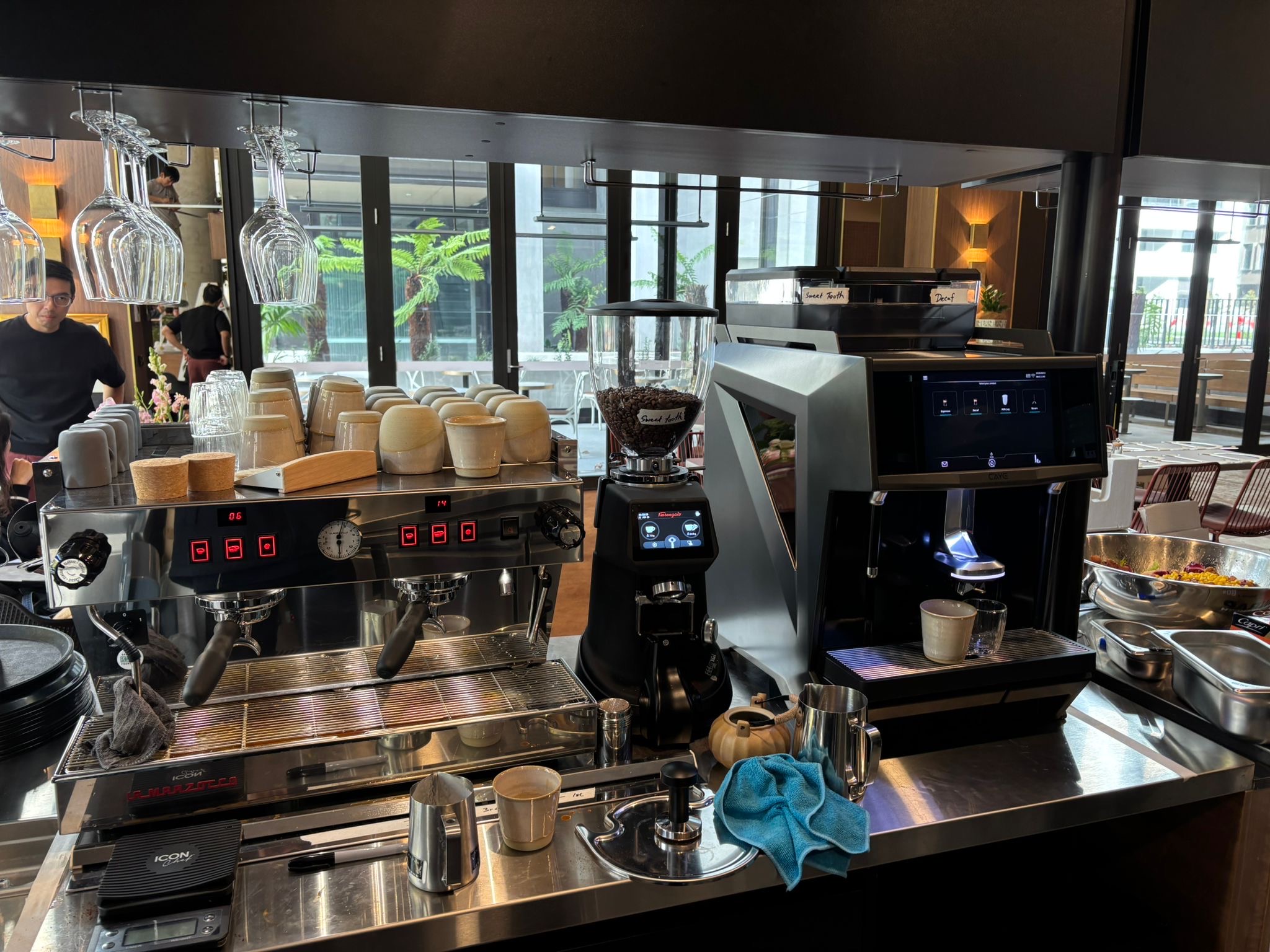
La Marzocco and a CAYE Super traditional Coffee machine
Frequently asked questions
Will customers notice that some coffees come from an automatic machine? Not in a negative way. The hybrid model keeps the craft and the welcome human. The automatic machine handles repeatable drinks to your own recipe, so customers get the same quality, faster.
Do I need to replace my existing espresso machine? No. That’s the point of a hybrid bar. You keep your traditional 2 or 3 group machine and grinders for the craft, and add a super-automatic machine next to them for volume.
Is a hybrid coffee bar only for big cafés and chains? No. Any café with a regular peak can benefit. Single-site cafés often see the biggest difference, because one busy morning without a senior barista can make or break the day. Rental and leasing options also make it easier to start.
What about cleaning and maintenance? Modern super-automatic machines run automatic cleaning cycles, and connected machines can alert you when a clean is skipped or a fault is developing, so service can be booked before the morning rush.
How much space does a super-automatic machine need? Most fit on a standard counter beside your espresso machine. We assess your bar layout, power and water as part of every installation plan.
Talk to Pelican Rouge about your hybrid coffee bar
At Pelican Rouge, we start with your volumes, your peaks and your team, not the catalogue. We’ll help you:
- Work out whether a hybrid setup pays back in your café, using your own numbers
- Choose the right super-automatic machine to sit beside your espresso machine and grinders
- Program your recipes so every coffee matches your standard
- Keep everything running with local service across Australia
- Find the right option to buy, rent or lease
Ready to see the numbers for your café? Contact the Pelican Rouge team for a free payback check over a coffee.
Sources: CreditorWatch Business Risk Index (January and July 2026); Fair Work Commission Annual Wage Reviews 2022 to 2026; Jobs and Skills Australia, Accommodation and Food Services industry profile; La Marzocco Australia Future of Coffee report and Time Out Australia (average cup price); Ubermilk café case study via Specialist Espresso (supplier-measured). The payback example and peak-hour figures are illustrative and based on the stated assumptions.