A comprehensive guide to how intelligent modular design, real-time IoT telemetry, and automated quality control are eliminating downtime, reducing operational complexity, and building more profitable coffee businesses across Australia.
Introduction: The Cup That Defines Your Venue
In Australia — and nowhere more acutely than Melbourne — coffee is not a product. It is a cultural institution, a daily ritual, and in the hospitality context, a primary driver of venue identity. The quality, consistency, and reliability of your coffee service determines whether guests return, whether your front-of-house team feels confident, and in a very direct sense, whether your business is as profitable as it should be.
For decades, that coffee service has been built around one of the most elegant pieces of engineering the food and beverage industry has ever produced: the traditional commercial espresso machine. Two groups, three groups, paired with a precision grinder, operated by a skilled barista. In the right setting, with the right team, this setup is capable of producing coffee that rivals the finest in the world.
But the hospitality industry in 2026 is not the hospitality industry of 2006. Labour markets have tightened dramatically. The expectation of consistency across venues and shifts has risen. Multi-site operations are more common. Margins are under more pressure than at any point in recent memory. And the cost of a two-to-seven-day machine breakdown — to revenue, to reputation, and to team morale — has never been higher.
Against this backdrop, a new category of commercial espresso machine has emerged that fundamentally challenges the assumptions underlying traditional setup. Not by compromising on quality — but by engineering quality, consistency, and operational resilience into the machine itself. This is the CAYE Smart Series, distributed in Australia by Pelican Rouge, and this article is the most comprehensive examination of why operators across the country are beginning to look at commercial coffee infrastructure in an entirely new way.
We will cover the real operational weaknesses of traditional espresso setups, the engineering philosophy behind the CAYE platform, the transformative role of IoT telemetry and predictive maintenance, the modular architecture that has reduced repair time from days to minutes, the specialty coffee story that underpins every cup, and the full financial case for making the switch. By the end, you will have everything you need to make an informed decision about the future of coffee in your venue.
Section 1: The Traditional Commercial Espresso Setup — An Honest Assessment
Any honest discussion of commercial coffee equipment must begin from a position of respect for the traditional espresso machine. The two-group and three-group commercial machines that have defined café culture for the past half-century are genuine engineering achievements — precision instruments capable of extraordinary output in the right hands. This article is not a dismissal of that heritage. It is an examination of where the traditional setup’s structural limitations have become increasingly difficult for modern operators to absorb.
The Craft Ceiling and the Consistency Floor
The traditional espresso setup has a high ceiling and a variable floor. At its best — a senior barista, freshly dialled-in grinder, premium beans in optimal condition — it produces coffee of exceptional quality and character. The theatre of watching a skilled operator work the machine is itself part of the hospitality offering, particularly in Melbourne’s café culture where the craft of espresso is deeply valued by guests.
But beneath that ceiling is a floor that shifts constantly. Grind consistency drifts throughout the day as burr temperature changes. Bean batch transitions introduce new moisture content and density variables that affect extraction. Staff changes between morning and afternoon shifts mean the person operating the machine at 2pm may have a fraction of the skill and tactile intuition of the person who started the day. The result is that the gap between the best cup and the worst cup produced by a traditional setup on any given day can be substantial — and in many venues, the guest experience is entirely dependent on which point of that range they happen to land on.
The Grinder: An Underappreciated Variable
In most discussions of commercial espresso equipment, the grinder receives insufficient attention relative to the machine itself. This is a mistake. The grinder is arguably more important than the machine in determining extraction quality — because the quality of the espresso shot is fundamentally determined by the consistency, accuracy, and particle size distribution of the grind.
A traditional commercial grinder — even a high-quality one — requires manual adjustment throughout the day. Temperature affects burr gap and therefore particle size. As the burrs warm up during a busy morning service, grind particle size shifts, extraction time changes, and the cup changes with it. An experienced barista monitors this continuously and makes ongoing micro-adjustments. In a venue with consistent, skilled staffing, this works. In a venue where staffing rotates, where junior team members cover quiet periods, or where the senior barista is managing multiple responsibilities simultaneously, the grinder becomes a significant and often invisible point of quality variability.
Reactive Maintenance: The Structural Risk
The most significant operational weakness of the traditional espresso setup is not quality variation — it is the complete absence of any early warning system for mechanical failure. Traditional commercial espresso machines are closed systems. They provide no operational data, no performance metrics, no component health indicators, and no communication of any kind with the operator or service provider until something goes wrong.
When something does go wrong, the sequence of events is painfully familiar to anyone who has operated a hospitality venue. A component fails — often during peak service, because peak service is when the machine is working hardest. The machine stops producing coffee, or produces it poorly. A technician is called. The technician diagnoses the fault — a process that typically takes thirty to sixty minutes on a complex machine. If the required part is not in the technician’s vehicle, it must be ordered. Parts delivery in Australia can take one to five business days. The technician returns for a second visit to install the part. The machine is returned to service.
Conservative industry estimates place the total downtime window at two to seven days per major incident. For a venue relying on coffee as a primary revenue driver, that window is not an inconvenience — it is a genuine business crisis.
Two to seven days of machine downtime at 200 cups per day is not an inconvenience. At $5.50 per cup, it is between $2,200 and $8,500 in lost revenue — before accounting for reputation and repeat customers.
Multi-Site Management: Where Traditional Setups Show Their Age
For operators running more than one venue, the challenges of the traditional espresso setup compound in proportion to the number of sites. Each machine exists as an independent system. There is no centralised visibility into machine performance, no way to confirm that recipe standards are being maintained consistently across locations, no early warning of developing faults, and no mechanism for rolling out a recipe or menu change across the fleet simultaneously.
Managing quality and consistency across five, ten, or twenty traditional setups requires significant and ongoing management investment — and even with that investment, the outcome is never truly uniform. The human variable is always present, and the management overhead required to contain it grows linearly with the number of sites.
Section 2: The CAYE Smart Series — A Different Engineering Philosophy
The CAYE Smart Series does not attempt to be a better version of the traditional commercial espresso machine. It operates from an entirely different engineering philosophy — one that starts from the premise that quality and consistency are not in tension with automation, but are in fact best achieved through intelligent automation.
CAYE describes its platform as a super-traditional fully automatic commercial espresso machine. The terminology is deliberate and important. Super-traditional because the machine replicates every stage of the expert barista’s workflow — the same fundamentals of precision grinding, controlled tamping, managed extraction, and expertly textured milk that define great espresso. Fully automatic because every one of those stages is automated, monitored, and controlled by hardware and software systems that operate to tolerances no human hand can consistently achieve across hundreds of cups.
CAYE is not a vending machine. It is not a pod machine in a premium enclosure. It is a commercial-grade espresso system built on the same foundational principles as the world’s finest traditional machines — but with one transformational difference: every variable is under continuous automated control, and every cup is the product of the same precision, regardless of who pressed the button.
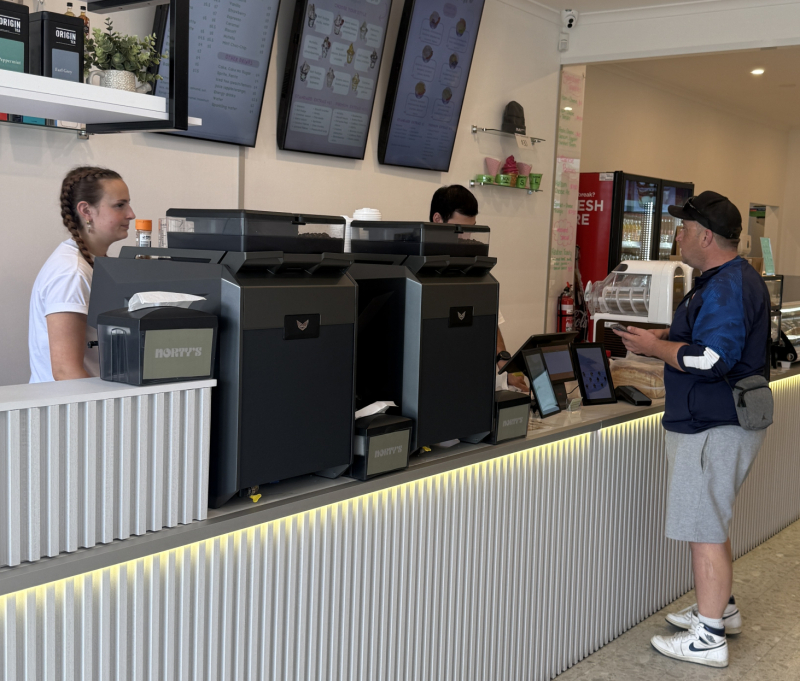
Two CAYE Smart X at Nortys in Rosebud Melbourne
The Global Technology Credentials
- CAYE is a recognised technology leader in automated espresso ~200 global patent applications
- Annual production capacity from CAYE’s Suzhou manufacturing facility 10,000+ units
- Smart X throughput — up to 250 cups suggested daily output 156 cups/hr
- Smart X Master throughput — up to 500 cups suggested daily output 258 cups/hr
These are not the credentials of a startup or a niche player. CAYE is a global commercial manufacturer with approximately 200 patent applications covering its core technologies — a scale of intellectual property development that reflects genuine long-term investment in this category. The 10,000+ unit annual production capacity from the Suzhou facility confirms that this technology is deployed at commercial scale, not in limited pilots.
Section 3: The Bionic Barista — Five Stages of Automated Precision
The centrepiece of the CAYE Smart Series is the Bionic Barista system — a fully integrated automation architecture that replicates each of the five stages of expert espresso preparation with hardware precision and software intelligence. Understanding how this works at each stage is essential to understanding why the quality output of a CAYE machine can genuinely rival that of a skilled traditional barista.
Stage 1: Grinding and Weighing
The foundation of any great espresso is the grind. The CAYE grinding system uses CPS ceramic burrs powered by a silent BLDC (Brushless DC) motor. Ceramic burrs offer superior thermal consistency compared to steel during extended operation — meaning the particle size distribution remains stable across a long and busy service, rather than drifting as burr temperature rises.
The AccuPowderWeigh technology controls coffee dose to within ±0.2 grams of accuracy. To put this in context: a dose variation of even 0.5g in a traditional setup can meaningfully alter the brew ratio and therefore the flavour of the resulting cup. CAYE’s ±0.2g tolerance is a level of precision that even an experienced barista using a quality scale would struggle to match consistently at pace. Particle size variation is held below 40 microns — delivering ultra-consistent extraction repeatability across every single grind cycle.
Stage 2: Distribution and Tamping
After grinding, the distribution and tamping stage determines how evenly the coffee bed is prepared for water contact. In a traditional setup, the barista taps the portafilter, levels the bed, and tamps manually — a process that introduces significant variability in density, levelness, and pressure between individuals and even between consecutive shots by the same person.
CAYE’s VVD (Vertical Vibrating Distribution) system replicates the experienced barista’s portafilter levelling technique using controlled vertical vibrations that evenly distribute and level the coffee bed before tamping. This step directly addresses one of the most common causes of extraction failure: channelling. Channelling occurs when water finds a path of least resistance through an unevenly distributed coffee bed, resulting in under-extracted coffee from some areas and over-extracted coffee from others. The VVD system eliminates this variable by ensuring a consistently level, evenly distributed coffee bed on every cycle.
Stage 3: Brewing and Extraction
The extraction stage is where the CAYE platform introduces its most significant technological advance: the CLS (Closed-Loop System). This is CAYE’s designation for what it describes as the world-first genuine quality control mechanism for espresso extraction implemented in a commercial machine.
Traditional espresso machines use open-loop or semi-open-loop extraction systems — they estimate extraction output based on time or volumetric flow measurements. These estimates are functional under stable conditions but become inaccurate when variables shift — bean batch changes, ambient humidity fluctuations, or burr wear all affect the relationship between time/volume and actual extraction quality.
The CLS operates differently. It monitors actual extraction weight via the AccuLiquidWeigh system — measuring the weight of extracted liquid directly, rather than estimating it from flow rate. This provides more accurate control over extraction duration and brew ratio. Critically, the CLS auto-adjusts grind size after every single extraction cycle, continuously recalibrating to maintain the target extraction parameters regardless of changing conditions. The system also uses reverse gravity extraction and vertical infusion to maximise extraction efficiency at the brew head.
The practical outcome: once recipe parameters are set — coffee dose, brew ratio, extraction duration — the CLS maintains those parameters automatically and indefinitely, across thousands of serves, regardless of environmental or bean batch variation. A one-button daily calibration handles the start-of-day reset when beans are changed. Beyond that, the system manages itself.
Stage 4: Milk Frothing
Milk frothing is one of the most technically demanding skills in café operation — and one of the most difficult to train consistently. The quality of frothed milk, its texture and temperature, has a profound impact on the quality of the finished drink, particularly in the flat whites and lattes that dominate Australian café orders.
CAYE’s SuperMix frothing technology addresses this through a two-stage process. First, a swirling motion accelerates the fusion of air and milk proteins, creating the structural foundation of quality frothed milk. This is followed by high-pressure steam infusion that develops the final texture. The result is consistently dense, smooth, high-quality frothed milk — matching the output of a skilled barista’s steam wand technique on every cycle.
Stage 5: Quality Control and Continuous Monitoring
The fifth stage is the one that distinguishes the CAYE platform most fundamentally from any traditional setup: continuous quality monitoring. The CLS does not simply execute the extraction — it evaluates it, logs the result, and adjusts parameters for the next cycle. Every cup is a data point. Every data point improves the next cup.
In the Smart X Master, DualShift Brewing mode takes this further still — using dual brewing chambers to dramatically increase output (up to 350 espressos per hour) while maintaining full CLS monitoring and adjustment across both chambers simultaneously.
Section 4: IoT Telemetry — The Operational Revolution
If the Bionic Barista system is the quality engine of the CAYE platform, the IoT telemetry architecture is its operational nervous system. And for operators focused on uptime, multi-site management, and long-term profitability, the telemetry system may ultimately be the more transformational feature.
Every CAYE machine deployed through Pelican Rouge Australia is continuously connected to a cloud-based IoT hub that transmits real-time operational data to both the venue operator and the Pelican Rouge service team. This is not a periodic data sync or a scheduled check-in. It is a live, continuous stream of machine health and performance information that enables a qualitatively different approach to machine management.
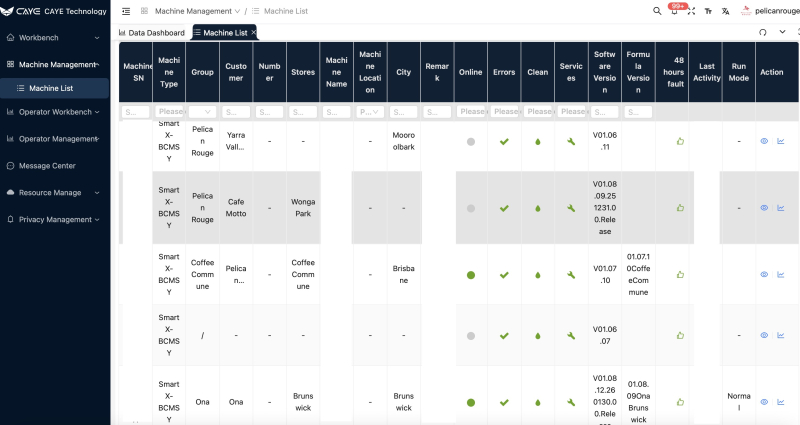
CAYE IoT List of machines on the field
What the IoT Platform Monitors in Real Time
The data streams available through the CAYE IoT platform cover every operationally significant aspect of machine performance:
- Machine status across all connected venues — live operational state, current recipe, active alerts
- Production data — volumes by hour, peak service throughput, daily and weekly totals
- Extraction quality metrics — dose weights, brew ratios, extraction durations, CLS adjustment history
- Component performance indicators — temperature profiles, pressure readings, motor load data
- Predictive maintenance flags — early warning signals triggered by deviation from established operating parameters
- Recipe and firmware version status — confirmation that all machines are running current configurations
The depth and breadth of this data stream represents a fundamental shift in what it means to manage a commercial coffee operation. Where a traditional setup provides the operator with exactly zero operational visibility between service visits, the CAYE IoT platform provides continuous, real-time, multi-site visibility from any internet-connected device.
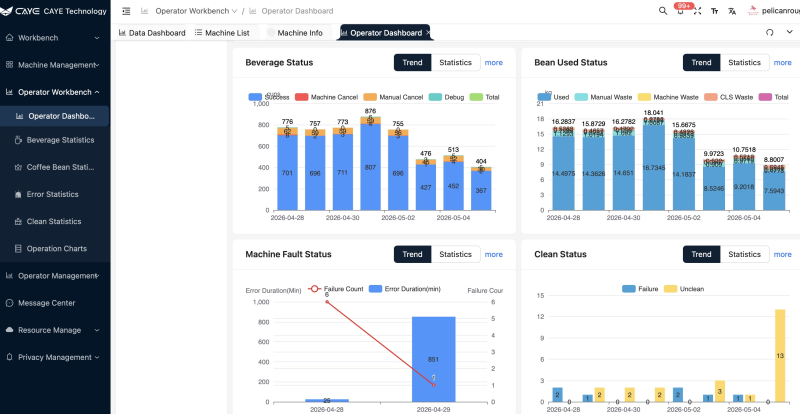
CAYE IoT Operator Dashboard
Predictive Maintenance: The Most Important Capability
Of all the capabilities enabled by the CAYE IoT platform, predictive maintenance is the one with the most direct and measurable impact on venue profitability. The logic is straightforward but profound: if you can identify that a component is trending toward failure before it actually fails, you can intervene proactively — scheduling maintenance at a convenient time, with the right parts already in hand — rather than reactively, in the middle of a service crisis.
Traditional espresso machines cannot do this. They have no mechanism for communicating developing faults. The first indication of a problem is the problem itself — a machine that will not produce coffee, or produces it incorrectly, at the worst possible moment.
The CAYE platform’s predictive maintenance capability changes this dynamic entirely. Pelican Rouge’s service team monitors the IoT data from every deployed machine. When a component begins to show performance deviation — a temperature profile that is drifting, a pressure reading that is trending outside normal parameters, a motor load that is increasing — the system flags the anomaly. The service team reviews it, determines whether intervention is warranted, and if so, dispatches a technician proactively, with the relevant replacement module already prepared.
The result is maintenance that happens on the operator’s schedule rather than at the worst possible moment. Downtime that is planned for minutes during a quiet period, not discovered as a crisis during Saturday morning peak service.
Remote Recipe Management
For multi-site operators, the IoT platform’s remote recipe management capability delivers significant ongoing operational value. Recipe updates — changes to brew ratios, extraction parameters, milk temperatures, or menu configurations — can be pushed to every connected machine simultaneously, from a single interface, without a technician visit to each site.
In a traditional setup, rolling out a recipe change across ten venues requires either sending a representative to each site to make manual adjustments (with all the risk of inconsistent implementation that implies) or trusting that site-level staff will implement changes correctly based on written instructions. Neither approach is reliable at scale.
With the CAYE IoT platform, a recipe update is pushed once and confirmed as received and implemented across every machine in the fleet. The brand standard is protected. The consistency is guaranteed. And the management overhead is a fraction of what the traditional approach requires.
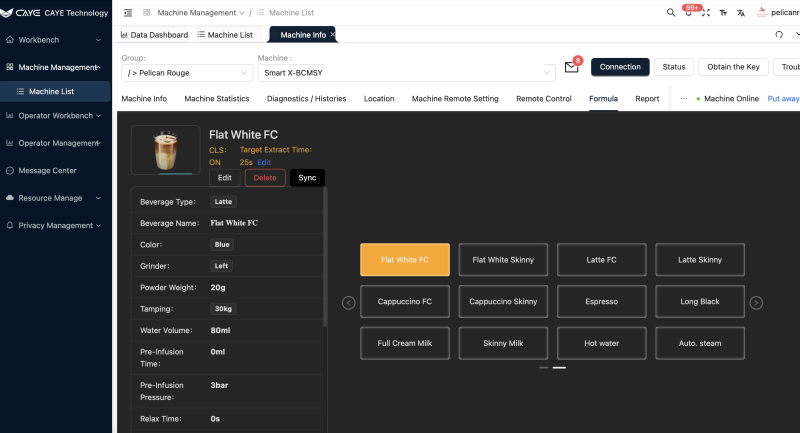
CAYE IoT receipt management
OTA Firmware Updates
One of the less immediately obvious but genuinely significant capabilities of the CAYE IoT platform is over-the-air (OTA) firmware updates. Like a modern smartphone or laptop that receives software improvements automatically, CAYE machines can receive firmware updates remotely — adding features, improving performance, and addressing any software-level issues without requiring a service visit.
This has a compounding benefit over the operational life of the machine. A CAYE Smart X installed today will not perform identically to how it performs in three years — not because it will have degraded, but because it will have improved. Software refinements to the CLS algorithms, improvements to the IoT monitoring interface, new features added to the recipe management system — all of these reach the installed machine automatically, without any cost or effort from the operator.
No traditional espresso machine can do this. A traditional machine purchased today performs exactly as it will in ten years, barring mechanical wear. The CAYE platform is designed to get better.
ERP Integration and Operational Data
For larger operators and multi-site groups, the CAYE IoT platform also supports integration with ERP systems via open API. Production data — volumes, peak hours, throughput — can feed directly into operational management and KPI tracking systems, providing a level of coffee-specific business intelligence that was simply not available before this class of machine existed.
Spare part inventory management data is also available through the platform, enabling proactive stock management rather than reactive emergency ordering.
Section 5: Modular Architecture — Reinventing What Downtime Means
The IoT telemetry system dramatically reduces the likelihood of unexpected breakdowns by enabling proactive intervention. But CAYE’s engineering team understood that even with the best predictive maintenance in the world, components will occasionally fail without sufficient warning. The modular architecture is the answer to that residual risk — and it is perhaps the most elegant engineering solution in the entire CAYE platform.
Six Modules, Sub-Three-Minute Swap
The CAYE Smart Series is engineered around six distinct functional modules, each designed as a self-contained unit that can be identified, removed, and replaced by a trained technician in under three minutes:
- Grinder Module — the grinding and weighing system
- Brew Module — the extraction and brewing head
- Milk Module — the frothing and milk delivery system
- Control Module — the processing and interface system
- IoT Module — the connectivity and telemetry hardware
- System components — ancillary modules as required
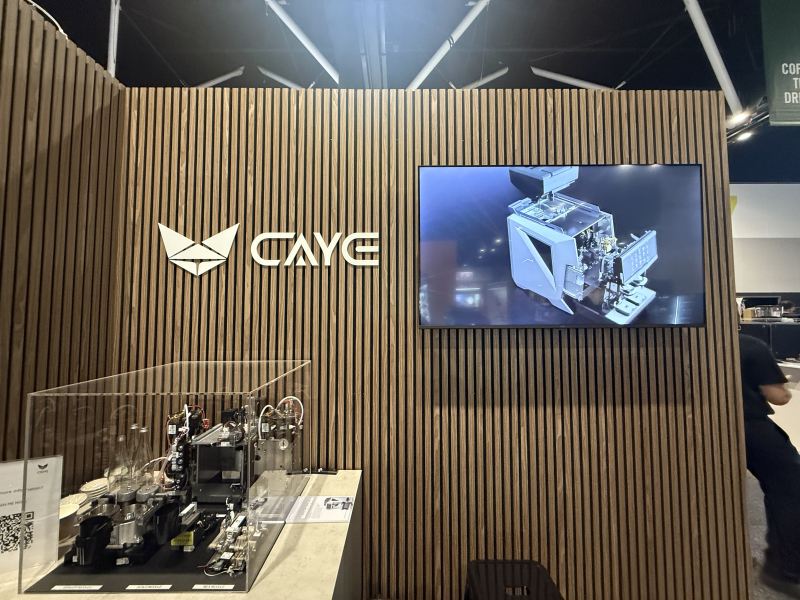
CAYE Smart X Modular Super Traditional Coffee Machine
The critical design principle here is that no module repair requires the machine to be taken off-site, no part needs to be ordered after diagnosis, and no second technician visit is needed. Pelican Rouge holds stocked spare modules at its Croydon South facility, available for same-day dispatch. When a module requires replacement, the technician arrives with the replacement unit already in hand.
The Breakdown Scenario Compared
The following comparison illustrates the operational reality for a venue experiencing a significant machine fault.
Traditional machine — major fault during peak service:
- Fault occurs — machine stops or degrades during service
- Technician called — estimated arrival 2–4 hours
- Technician diagnoses fault on-site — 30 to 60 minutes
- Replacement part identified — not in technician’s vehicle
- Part ordered — 1 to 5 business days for delivery
- Technician returns for repair — additional half-day
- Machine returned to service
- Total downtime: 2 to 7 days. Revenue and reputation impact: significant.
CAYE Smart X — same scenario:
- IoT telemetry detects component deviation before failure
- Pelican Rouge service team alerted automatically
- Technician dispatched proactively with replacement module in hand
- Faulty module identified and removed — 2 minutes
- Replacement module inserted and verified — 1 minute
- Machine returned to service — under 10 minutes total downtime
- Total downtime: under 10 minutes. Revenue impact: zero.
“Under 10 minutes of downtime, versus 2 to 7 days. This is not an incremental improvement — it is a categorical shift in the operational risk profile of running a commercial coffee operation.”
For a venue averaging 200 cups per day at $5.50 per cup, the difference between a four-day traditional machine breakdown ($4,400 in lost revenue) and a CAYE module swap (zero lost revenue) is not a marginal line item. It is a meaningful, recurring, and entirely avoidable difference in annual profitability.
The Pelican Rouge Service Model
The modular architecture is only as powerful as the service organisation behind it. Pelican Rouge Australia’s service model is specifically designed to maximise the operational benefit of CAYE’s engineering:
- Real-time remote monitoring of every deployed machine through the IoT platform
- Preventative maintenance scheduling driven by actual usage data rather than calendar estimates
- Stocked spare modules held locally at the Croydon South facility — no waiting for parts to arrive
- Rapid-response field technicians across the Melbourne metropolitan area
- Proactive fault intervention — technicians dispatched before failure occurs wherever possible
The goal, stated plainly, is that no AVC or Pelican Rouge venue ever loses a coffee service due to machine downtime. The combination of predictive IoT monitoring, modular architecture, and local spare part inventory makes this goal operationally achievable in a way that no traditional service model can match.
Section 6: Specialty Coffee at Scale — The ONA Coffee Partnership
A legitimate question for any operator considering a super-traditional automatic machine is whether the coffee quality can genuinely compete with the output of a traditional setup using specialty beans. It is a fair question, and the answer requires understanding both the sourcing and the extraction technology behind every CAYE cup.
ONA Coffee — One of Australia’s Most Celebrated Specialty Roasters
The CAYE Smart Series, as deployed through Pelican Rouge Australia, is powered by a specialty roast developed in partnership with ONA Coffee. For those unfamiliar with ONA’s credentials: this is not a generic roaster supplying a commodity blend. ONA Coffee is one of Australia’s most celebrated specialty coffee companies, operating roasteries and cafés across Canberra and Sydney, and competing multiple times of the World Barista Championship — the global competition that defines the pinnacle of specialty espresso craft.
ONA’s precision roasting profiles are developed to showcase the origin character of their green coffee selections, with particular focus on delivering clarity, sweetness, and complexity in the cup. These are roasting profiles designed for specialty espresso — for extraction through traditional machines by skilled baristas who understand how to draw the best from them.
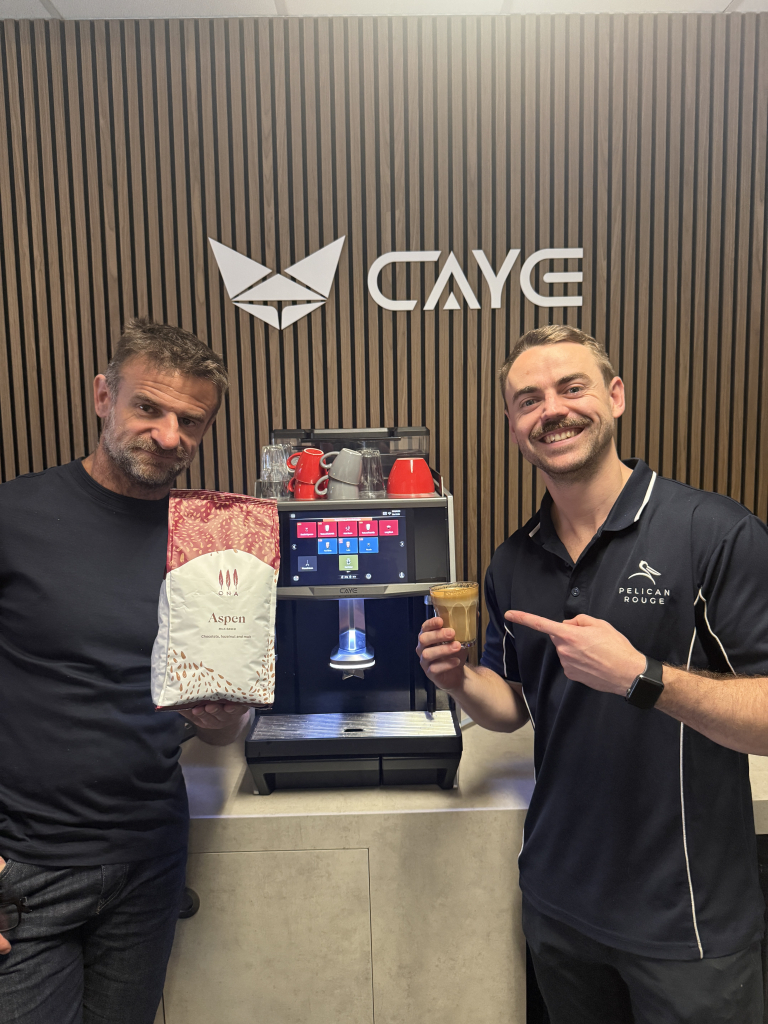
The Coffee Man Sasa Sestic with Brayden from Pelican Rouge working on profiling some ONA Coffee with the CAYE
What Happens When ONA Meets CLS
The combination of ONA’s specialty roasting profiles with CAYE’s CLS extraction system is where the coffee quality story becomes genuinely compelling. The CLS’s ability to maintain dose weight, brew ratio, extraction duration, and grind size to tolerances of ±0.2g and sub-40µm particle variation means that the extraction parameters designed to showcase ONA’s roast profiles are executed with a consistency that simply cannot be matched manually across high-volume service.
In a traditional setup with the same ONA beans, the quality of the extraction depends entirely on the skill of the barista operating the machine at that moment. At its best — an expert, focused, and in rhythm — the result is exceptional. At its worst — a junior staff member, a busy service, a grinder that has drifted — the same beans produce a noticeably inferior cup.
With the CAYE CLS system, the extraction parameters are held constant. The ONA beans are extracted the same way on the 5th cup of the day as on the 500th. The specialty character of the coffee — the clarity, the sweetness, the complexity that ONA’s roasters work to develop — is reproduced faithfully on every cup, by any operator, at any time of day.
The result is a coffee experience that genuinely rivals the finest Melbourne cafés — not occasionally, not when conditions are ideal, but consistently, at the push of a button, at every venue.
Section 7: Machine Flexibility — The 1-Step, 1.5-Step, 2-Step Architecture
One of the most frequently misunderstood aspects of super-traditional automatic machines is the assumption that they impose a single, rigid service mode. The CAYE Smart X is specifically designed to challenge this assumption.
The Smart X is configurable as a 1-step, 1.5-step, or 2-step machine — giving operators the ability to adapt the machine to their service environment, their staffing profile, and their guests’ expectations, without changing the hardware.
1-Step: Maximum Throughput Automatic
In 1-step mode, both coffee and milk are delivered automatically through a single process. This is the highest-throughput configuration, ideal for high-volume takeaway service, self-service stations, or peak periods when speed is the overriding priority. Minimal barista skill is required, and the machine can be operated confidently by junior team members after brief training.
1.5-Step: The Flexible Middle Ground
The 1.5-step configuration is perhaps the most operationally versatile. Coffee is delivered from the group head automatically, while milk can be handled either via the automatic outlet or via the steam wand — giving skilled team members the ability to produce latte art when time and skill allow, while maintaining throughput when service pressure requires it. This mode is ideal for mixed-service environments where the quality bar and the speed requirement both need to be met.
2-Step: Full Barista Creative Control
In 2-step mode, coffee is produced automatically from the group head, but milk is handled entirely via the steam wand. This gives a senior barista full creative control over milk texture and temperature — the mode that most closely mirrors the traditional machine experience while retaining the CLS extraction consistency of the CAYE platform. For venues where latte art and barista showmanship are part of the guest experience, 2-step mode preserves that element completely.
The significance of this flexibility cannot be overstated. A single CAYE Smart X can function as a high-volume automatic service machine during the morning rush, a flexible mixed-service tool during quieter periods, and a barista showcase during experience-focused service — all without changing the machine, and all while maintaining the same CLS extraction quality throughout.
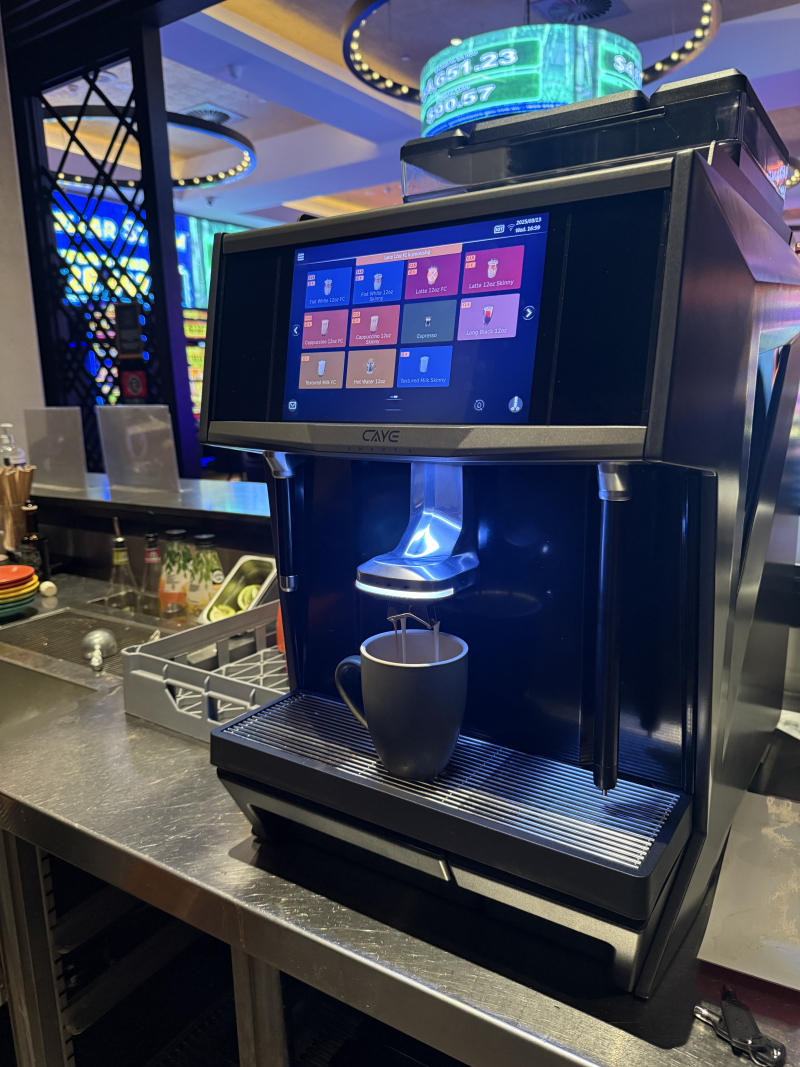
CAYE Smart X in a Sydney Club
Section 8: Smart X vs Smart X Master — Choosing the Right Platform
The CAYE Smart Series is available in two configurations, designed to map to different venue types and output requirements.
CAYE Smart X — The Versatile Performer
The Smart X is the more versatile of the two platforms, designed for venues with moderate-to-high output requirements and a preference for operational flexibility. Key specifications:
- Suggested daily output: 250 cups
- Hourly throughput: 156 cups
- Espresso/Cappuccino production rate: 175 per hour each
- Grinders: selectable 1, 2, or 3 grinders
- Burr size and type: 64mm ceramic
- Bean hoppers: 2 × 1.2kg
- Coffee outlet: 1 metal group head
- Brew capacity: 24g or 30g selectable
- Touch display: 10.1-inch colour screen
- Power: 220–240V, 3,000W
- Weight: approximately 62kg
- Connectivity: WiFi, 4G, RJ45
- Modular design: Yes
- IoT capable: Yes
- Operating modes: 1-step, 1.5-step, 2-step
CAYE Smart X Master — High-Volume Powerhouse
The Smart X Master is designed for the highest-output environments — main bars at large venues, multi-station setups, and locations where throughput is the primary operational requirement. Key specifications:
- Suggested daily output: 500 cups
- Hourly throughput: 258 cups
- Espresso/Cappuccino production rate: 350 per hour with DualShift mode
- Grinders: selectable 2 grinders
- Burr size and type: 64mm ceramic
- Bean hoppers: 2 × 1.2kg
- Coffee outlets: 2 metal group heads (dual)
- Brew capacity: 24g or 30g selectable
- Touch display: 10.1-inch colour screen
- Power: 220–240V, 3,000W
- Weight: approximately 63kg
- Connectivity: WiFi, 4G, RJ45
- Modular design: Yes
- IoT capable: Yes
Both models run the same Bionic Barista technology, the same CLS Closed-Loop System, the same IoT telemetry platform, and the same modular architecture. The choice between them is a function of required throughput and venue type, not a compromise on capability or quality.
Section 9: The Financial Case — Building a More Profitable Coffee Operation
Every technology investment in a hospitality business must ultimately be justified on financial terms. The CAYE Smart Series case for return on investment is built across several distinct dimensions, each of which contributes to the overall profitability improvement that operators are experiencing.
The Downtime Cost Elimination
As established earlier in this article, a four-day breakdown on a traditional espresso machine at a venue averaging 200 cups per day at $5.50 per cup represents approximately $4,400 in direct lost coffee revenue. This does not account for the secondary effects: reduced table turns, guests who order alternative beverages at lower margins, or — most significantly — the repeat customers who experience a degraded visit and choose a competitor for their next occasion.
With the CAYE platform, modular swap time under ten minutes and predictive maintenance scheduling means that this scenario does not arise. The financial benefit of downtime elimination is not a one-time saving — it is a structural improvement to the revenue reliability of the coffee operation, compounding across every year of the machine’s operational life.
The Labour and Training Efficiency
The CAYE platform’s ability to produce consistent, quality coffee across all skill levels has a direct impact on labour economics. In a traditional setup, the quality ceiling of the coffee operation is determined by the skill level of the least experienced person operating the machine at any given time. Training junior staff to operate a traditional espresso machine to an acceptable quality standard takes time, and maintaining that standard across a rotating team requires ongoing supervision and investment.
With the CAYE CLS system managing extraction quality automatically, the skill level required to operate the machine is significantly lower. Junior staff can confidently operate the machine in 1-step or 1.5-step mode from their first shift. Senior baristas retain their craft value at the steam wand and in the 2-step operating mode. The overall training burden is reduced, and the quality floor is raised — simultaneously.
The Multi-Site Operational Savings
For operators managing multiple venues, the IoT platform’s remote management capabilities translate directly into reduced operational overhead. Recipe updates that previously required technician visits or reliance on manual staff implementation can be executed remotely across the entire fleet in minutes. Operational data that previously required manual reporting from each site is available in real time through a single dashboard. Predictive maintenance scheduling reduces both unplanned service visits and the associated disruption costs.
The aggregate operational saving for a multi-site operator — reduced service visits, reduced management overhead, reduced quality variation costs — is substantial, and it grows with the size of the fleet.
The Revenue Opportunity: Throughput and Consistency
Finally, the output capacity of the CAYE platform creates a direct revenue opportunity for high-volume venues. At 258 cups per hour on the Smart X Master, the machine’s throughput is not a constraint on service. And because every cup meets the same quality specification, the operator can serve confidently at that throughput without worrying about quality variation as speed increases.
In a traditional setup, throughput and quality are in tension — push the speed up, and quality variation increases. The CAYE platform decouples this relationship: throughput is a function of hardware capacity, and quality is managed separately by the CLS system. Both can be maximised simultaneously.
Conclusion: The Future of Commercial Coffee Infrastructure
The commercial espresso machine has not changed fundamentally in its operating principles for decades. The traditional two or three-group setup, paired with a precision grinder and operated by a skilled barista, has served the hospitality industry extraordinarily well — and in the right context, it continues to do so.
But the context of commercial hospitality in Australia in 2026 is different from the context of ten or twenty years ago. Labour markets are tighter. Margins are under more pressure. Multi-site operations are more common. Guest expectations of consistency are higher. And the cost of machine downtime — to revenue, to reputation, to team morale — has never been more significant.
The CAYE Smart Series, distributed in Australia by Pelican Rouge, addresses every one of these challenges from an engineering first-principles perspective. The Bionic Barista system eliminates quality variation across skill levels and shifts. The CLS Closed-Loop System maintains extraction parameters to tolerances no human can consistently achieve. The IoT telemetry platform transforms machine management from reactive to predictive. The modular architecture reduces repair time from days to minutes. And the ONA Coffee specialty roast ensures that every automated cup meets a specialty quality standard.
This is not a machine that asks operators to compromise on quality in exchange for consistency. It is a machine that delivers both, simultaneously, at scale. That combination — quality, consistency, reliability, and operational intelligence — is what makes the CAYE Smart Series the most significant development in commercial espresso equipment in a generation.
The question for operators is not whether this technology is ready. CAYE’s approximately 200 global patent applications and 10,000+ unit annual production capacity confirm that it is deployed and performing at commercial scale. The question is simpler: how much longer can you afford to operate without it?
About Pelican Rouge Australia
Pelican Rouge Australia is the Australian distributor for CAYE Technology’s Smart Series commercial espresso machines. Headquartered at 5 Squires Way, Croydon South VIC 3136, Pelican Rouge combines CAYE’s precision engineering with deep specialty coffee expertise, an always-on IoT service model, locally stocked spare module inventory, and rapid-response field technicians across the Melbourne metropolitan area. Every CAYE deployment is backed by our commitment that your venue will never lose a coffee service due to machine downtime.
Get in touch:
pelicanrouge.com.au | caye.com.au | 03 8761 6697
5 Squires Way, Croydon South VIC 3136